How to Protect Your Home from Power Surges During Ohio Thunderstorms
July 31, 2026
Tip: A simple way to keep it straight: liability = the other guy, and other coverages = you and your car. If you cause an accident, liability handles their injuries and their property; your own car and injuries are covered (if at all) by separate coverages like collision, other-than-collision, and medical coverages. When reviewing your policy, it's worth knowing not just that you have liability, but what other coverages you do or don't have, since that's what determines how well you're protected. An agent can walk you through exactly what's on your policy.
Quick Answer: Most power surges don't come from lightning. They come from inside your own house, from your AC compressor, furnace blower, or refrigerator cycling on and off. Lightning and utility grid switching cause the rare, high-energy surges that do the real damage, and Ohio's thunderstorm season from June through August is when those events spike. The most reliable protection uses two layers together: a whole-house surge protector installed at your electrical panel that knocks down the big surge before it spreads through your wiring, plus point-of-use surge protectors at your most sensitive electronics for the smaller stuff that gets past the first layer. Surge protectors wear out with use, typically lasting three to five years, so they need to be checked and eventually replaced.
You're watching the sky get dark outside your window, and somewhere off in the distance, thunder rolls. The lights flicker once, twice, then hold steady. An hour later the storm passes, and everything seems fine, until you notice the microwave clock is blinking, or the TV won't turn on, or your router needs to be unplugged and plugged back in just to get the internet working again. That's a power surge, and it already found its way into your house.
Here's what catches most homeowners off guard: the storm outside isn't usually the main threat. It's what's already happening inside your electrical panel every single day.
Where Surges Actually Come From
Most surges start at home, not in the sky. According to the National Electrical Manufacturers Association, up to 80 percent of surges originate inside a building. Every time your air conditioner compressor kicks on, your furnace blower starts, or your refrigerator motor cycles, it creates a small voltage spike as it draws power. Individually, these are minor. Over months and years, they add up, quietly shortening the lifespan of whatever's plugged in nearby.
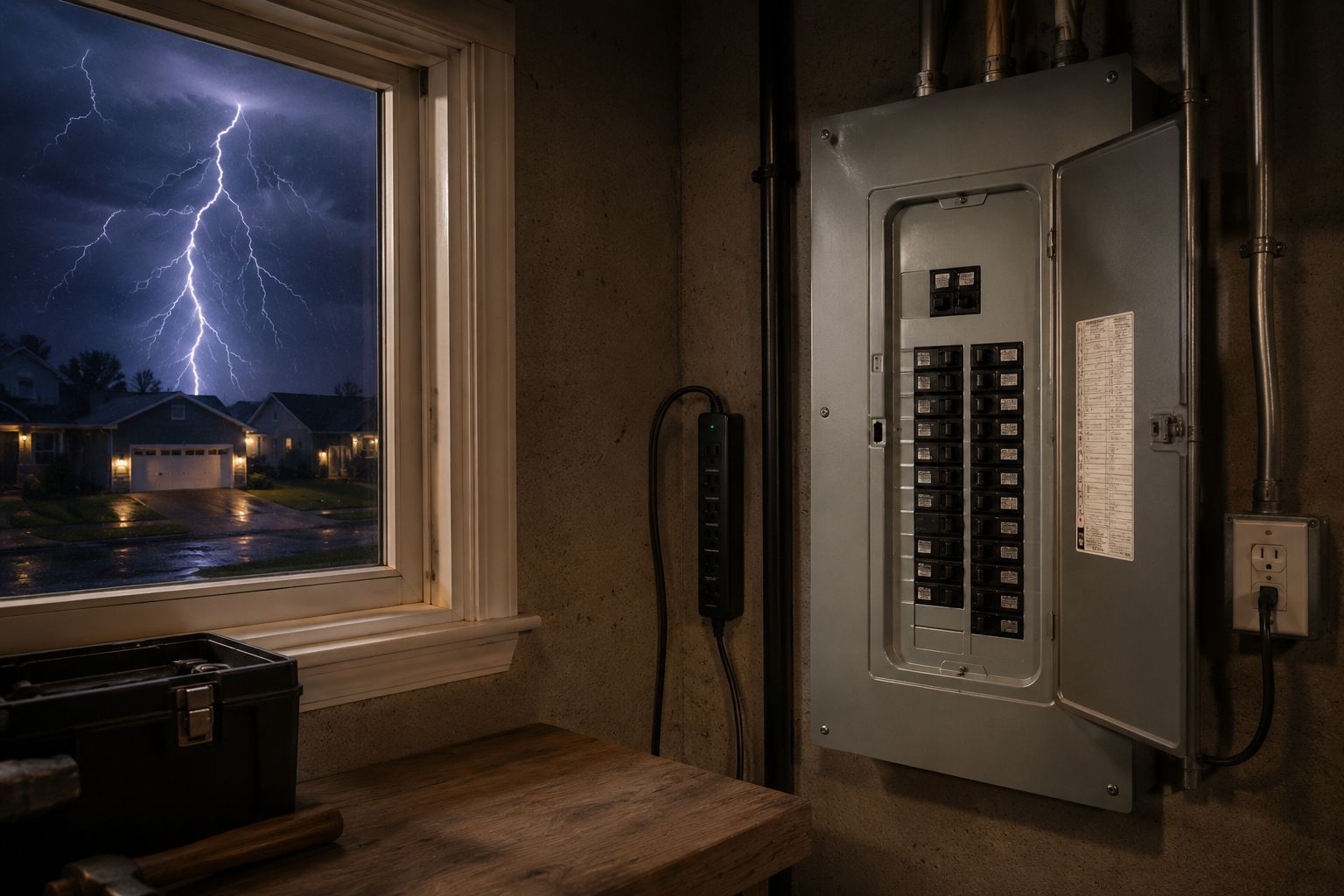
The other 20 percent is where thunderstorms come in, and this is the category that does the dramatic damage. A direct or nearby lightning strike can send a massive voltage spike racing through the electrical grid and into your home in a fraction of a second. Utility grid switching, the automated process that reroutes power during outages or equipment failures, can cause a similar spike even without a single bolt of lightning touching anywhere near your house. Northeast Ohio typically sees a couple dozen thunderstorm days a year, most of them packed into June, July, and August, which is exactly why surge damage tends to cluster in the summer months here.
How a Surge Actually Gets Into Your House
A surge doesn't need a direct hit to cause damage. It can travel in through the main electrical service line from the utility pole, but it can just as easily ride in through a cable TV line, a satellite dish connection, or a phone line. Any wire that runs from outside your home to something plugged into your wall is a potential entry point, which is part of why a device connected to both power and cable, like a modem or a smart TV, is often the first thing to go during a bad storm. That's also why surge protection has to cover more than just the outlets, since a device wired into two separate systems has two separate paths a surge can use to get in.
Signs a Surge Already Got Through
A few signs tell you a surge has already hit your system, and some of them mean stop what you're doing and check things out right now.
Tripped breakers and flickering lights are the most common. If a breaker trips during or right after a storm, or if lights across the house dim and flicker together rather than just one bulb, that's consistent with a surge event rather than a simple bulb going bad.
Blinking clocks and reset electronics show up on anything with a digital display, microwaves, ovens, cable boxes. If several of these reset to 12:00 or start blinking at the same time, a surge likely passed through your panel.
Warning: A burning smell or visible scorch marks at an outlet, switch, or panel is not a wait-and-see situation. Shut off power to that circuit at the breaker if you can safely reach it, and don't use that outlet again until it's been inspected. This is one of the more serious signs your electrical system took real damage.
A humming sound coming from an outlet or the panel itself is another one worth paying attention to, especially if it started right around the time of a storm.
Two Layers of Protection That Actually Work Together
Point-of-use protection covers what's plugged in
These are the surge-protector power strips you're probably already familiar with, or dedicated surge-protection outlets installed in specific spots like a kitchen countertop. They guard individual devices, computers, TVs, gaming systems, anything sitting on the other end of a cord. Not every power strip offers real surge protection, though. Unless the packaging specifically says so, assume it's just an extension cord with extra outlets.
Whole-house protection covers everything else
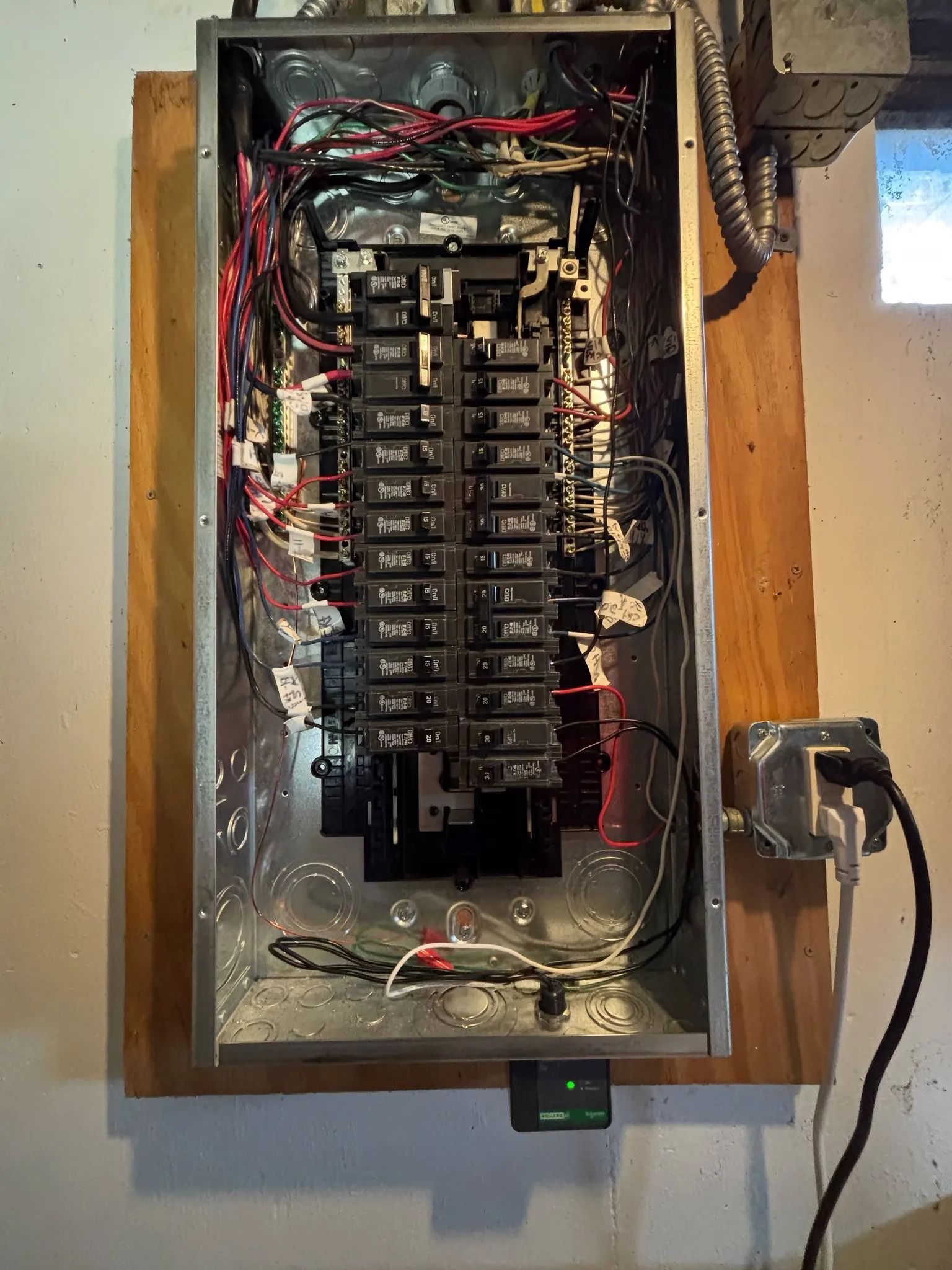
A service entrance surge protector, sometimes called a whole-house surge suppressor, gets installed directly at your electrical panel by a licensed electrician. It watches your entire incoming power supply and diverts excess voltage to ground before it can spread through your home's wiring. This is what protects the things a power strip never could: your furnace, central air system, water heater, range, and anything else hardwired directly into the panel rather than plugged into an outlet.
Used together, the two layers do different jobs. The whole-house unit absorbs the brunt of a major surge at the source, and the point-of-use devices catch whatever smaller voltage still makes it through to your most sensitive electronics. Relying on just one leaves a real gap, either your hardwired appliances are exposed, or your plugged-in electronics are taking the full force of anything that gets past the panel.
Surge Protectors Wear Out
A surge protector isn't a one-time install and forget it. Every time a unit absorbs a spike, it uses up some of its capacity to do it again. After enough events, or after one significant one, the protection is gone even though the device might still look and act normal. Most surge protectors have a working life of roughly three to five years, shorter in a house that sees frequent storm activity. Quality units include an indicator light or audible alert that signals when protection has failed. Check that indicator after any major storm, rather than assuming everything's still working as it did the day it was installed.
Frequently Asked Questions
Do I need a whole-house surge protector if I already use power strips?
Power strips only protect what's plugged into them. Anything hardwired into your panel, your HVAC system, water heater, range, and similar appliances, has no protection at all unless you add a service entrance surge protector. Most homes benefit from both layers rather than relying on one.
Can a power surge happen even when there's no storm?
Yes, and it's actually the more common scenario. Appliances cycling on and off inside your own home cause the majority of surges. Storms and utility grid events cause the less frequent but more damaging spikes.
How do I know if my surge protector still works?
Check for an indicator light or audible alert, most quality units include one. If a device doesn't have any way to signal failure, or if it's been through a major storm or several years of regular use, have it tested or replaced. Don't assume it's still protecting anything just because it looks fine.
Should I unplug electronics during a thunderstorm?
It's a reasonable extra precaution for your most sensitive or expensive electronics, but it isn't a substitute for actual surge protection, since you can't always predict or be home for every storm. A whole-house and point-of-use setup protects your system continuously, storm or no storm.
Does a whole-house surge protector protect against a direct lightning strike?
It cuts the damage way down from a nearby strike or one that enters through the utility lines, but a direct strike on the home itself involves so much energy that no surge protector is designed to fully absorb it. Whole-house protection is built around the grid-based and nearby-strike surges that are far more common.
Why do my electronics keep failing even though I use power strips?
If hardwired appliances or the home's overall electrical system have no service entrance protection, surges from lightning or grid switching can pass through the panel and stress everything downstream, including devices that are plugged into strips that only guard against smaller surges. Have the panel and grounding checked too, especially in an older home.
Getting Ahead of the Next Storm
Ohio's thunderstorm season comes back every summer, and so does the risk of a surge finding its way into your home's wiring. The homes that come through a bad storm without a fried appliance or a dead HVAC control board are usually the ones that had both layers of protection in place before the storm ever showed up, not after. If your home hasn't been checked for surge protection, or you're not sure whether your panel and grounding can support it, have someone look at the whole system instead of just adding another power strip.
Protecting your home from Ohio's storm season starts with knowing what your panel and wiring can actually handle. XH Electric, LLC
based in Parma, Ohio, can evaluate your home's grounding, install a
whole-house surge protector
at the panel, and point you toward the right point-of-use protection for your most sensitive electronics. With 10
years in the trade, licensed and insured, BBB accredited, and no hidden fees, the team works on older Cleveland-area homes every week and knows what those panels and wiring systems need. Reach out before the next storm rolls through to get your home's surge protection evaluated.